

SEE Preparation Guide 2083: How to Prepare Month by Month
The preparation for SEE begins from the month of Mangsir. Complete your syllabus by the end of Mangsir. Then repair your poorly worded chapters in Poush. Work on past papers in Magh, and take full mocks in Falgun. Light revision with Chaitra. There is one rule that is most important. In the theory paper of each subject, score a minimum of 35%, as it will keep you out of NG.
How to Prepare for SEE in 5 Steps
- Finish the full syllabus by the end of Mangsir.
- Spend Poush on your three weakest chapters in each subject.
- Solve two past or model papers every week in Magh.
- Sit timed mock exams for every subject in Falgun.
- Revise only your short notes in Chaitra, and sleep well.
This guide is written by the teachers who prepare our own Class 10 students at United Universal School every year. You will find a clear monthly plan, a daily timetable, tips for each subject and answers to the questions students ask us most.
Get the free SEE 2083 study timetable. Scroll Down ->
What Is SEE and Why Does Preparation Matter in 2083?
SEE stands for Secondary Education Examination. It is the national exam every Class 10 student in Nepal takes. The National Examination Board (NEB) runs it. Your SEE result decides which +2 stream and which college you can join next.
There are minimum marks required in the SEE and this is why good preparation is essential. An estimated 4.3 lakh students took the test in SEE 2082. Of them, 146,507 students got NG in at least one subject. This is about 1 in 3 students. Many of them could have saved themselves from it if only they had a plan and practiced it early!
SEE 2083 Exam Dates and Key Deadlines
These are the main dates from NEB's 2083 calendar. Always check the final dates on neb.gov.np because NEB can change them.
|
What happens |
When |
|
Class 10 SEE form entry |
Mangsir 25 to end of Poush 2083 |
|
SEE routine published |
1st week of Magh 2083 |
|
Internal and practical marks sent to NEB |
By end of Falgun 2083 |
|
SEE exam starts |
1st or 2nd week of Chaitra 2083 |
|
SEE result |
By 2nd week of Jestha 2084 |
|
Grade increment (supplementary) exam |
From 1st week of Shrawan 2084 |
You can also see all school holidays and exam weeks on the UUS academic calendar.
SEE Grading System and the NG Rule Explained
SEE does not give you a pass or fail mark. Instead, it gives you a letter grade for each subject. Your final result is a GPA out of 4.0.
SEE Grade and GPA Table
|
Marks you score |
Grade |
Grade point |
|
90% and above |
A+ |
4.0 |
|
80% to below 90% |
A |
3.6 |
|
70% to below 80% |
B+ |
3.2 |
|
60% to below 70% |
B |
2.8 |
|
50% to below 60% |
C+ |
2.4 |
|
40% to below 50% |
C |
2.0 |
|
35% to below 40% |
D |
1.6 |
|
Below 35% |
NG |
Not graded |
The 35% Theory Rule and 40% Internal Rule
This is the rule that catches most students. In most subjects, the theory paper is worth 75 marks and internal assessment is worth 25 marks. You must pass both parts on their own.
- In theory, you need at least 35%. That means 27 marks out of 75.
- In internal or practical, you need at least 40%. That means 10 marks out of 25.
So even if your total looks fine, you still get NG if your theory score is 26. Keep this in mind from day one.
How Is Your Final SEE GPA Calculated?
Each subject has credit hours. Credit hours show how big a subject is, based on how much teaching time it gets. NEB multiplies your grade point in each subject by its credit hours. Then it adds them up and divides by the total credit hours. As a result, a high grade in a bigger subject lifts your GPA more. Your grade sheet shows the credit hours for each subject.
SEE Study Plan 2083: Month-by-Month Timeline
You have about four and a half months before the exam. That is enough time if you use it well. Our teachers break it down like this.
|
Month |
Main goal |
What to do each week |
|
Mangsir |
Finish the syllabus |
Complete every chapter you have not studied yet. Make short notes as you go. |
|
Poush |
Fix weak chapters |
List your 3 weakest chapters in each subject. Work on them first. |
|
Magh |
Practise past papers |
Solve at least 2 past or model papers every week. Check them with a teacher. |
|
Falgun |
Full mock exams |
Sit 3 hour mock exams with a timer. Treat them like the real exam. |
|
Chaitra |
Light revision |
Revise your notes and formulas. Sleep well. Do not start new chapters. |
Mangsir: Finish the Syllabus
Start by collecting your textbook, notes and the specification grid for each subject. The specification grid is an official chart from the Curriculum Development Centre (CDC). It shows how many marks each chapter carries. You can download it free from the resource list further down. Next, mark the chapters you have not finished. Then plan to finish all of them by the end of Mangsir. If you get stuck, ask your subject teacher the same week. Do not let doubts pile up.
Poush: Strengthen Weak Chapters
Now look honestly at your weak areas. Write down three weak chapters for each subject. Spend most of your study time on these chapters this month. At the same time, keep revising the easy chapters once a week so you do not forget them.
Magh: Solve Past Papers and Model Questions
The SEE routine usually comes out in the first week of Magh. Once it does, write your exam dates on your timetable. After that, start solving past papers. You can find model questions on the United Academy model questions page. Solve each paper in 3 hours, just like the real exam. Then check your answers and note your mistakes.
Falgun: Full Mock Exams Under Exam Conditions
Take at least one full mock test of each subject in Falgun. Use a timer while taking them. Lock your mobile in another room. Try to write legibly like you would do in the examination hall. Apart from this, almost all the schools conduct pre-board examinations at this point in time.
Chaitra: Final Revision and Rest
Last few weeks are used only for revision. Review your short notes, formulas and diagrams. Sleep at least 7 to 8 hours per day. Eat home food. Relax yourself and believe in your preparation.
Daily Study Timetable for SEE Students
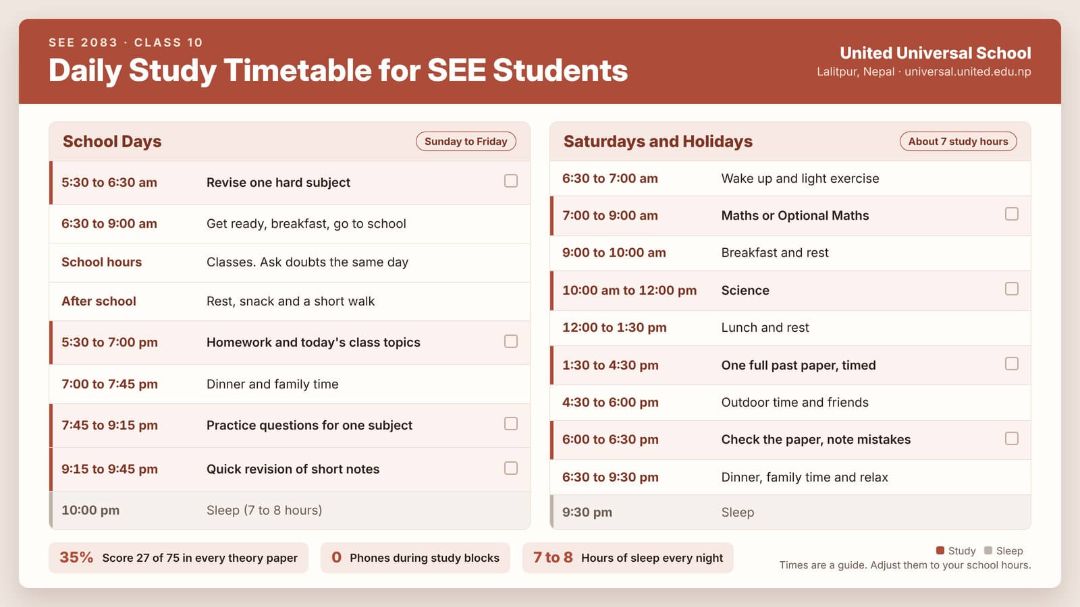
A timetable keeps you steady. It also stops you from spending all your time on your favourite subject. Our Class 10 students follow a simple plan like this one.
School-Day Timetable (Sunday to Friday)
|
Time |
Activity |
|
5:30 am to 6:30 am |
Revise one hard subject (your mind is fresh) |
|
6:30 am to 9:00 am |
Get ready, breakfast, school |
|
After school |
Rest, snack and a short walk (45 minutes) |
|
5:30 pm to 7:00 pm |
Homework and today's class topics |
|
7:00 pm to 7:45 pm |
Dinner and family time |
|
7:45 pm to 9:15 pm |
Practice questions for one subject |
|
9:15 pm to 9:45 pm |
Quick revision of short notes |
|
10:00 pm |
Sleep |
Saturday and Holiday Timetable
On Saturdays, study in three blocks of about two hours each. For example, do Maths in the morning, Science before lunch and a full past paper in the afternoon. Take a proper break between blocks. Use the evening to rest and meet friends.
How Many Hours Should You Study Daily for SEE?
Most students do well with 3 to 4 focused hours on school days and 6 to 7 hours on holidays. Focused means no phone and no TV in the room. Two hours of real focus beat five hours of half study.
Subject-Wise SEE Preparation Tips
Each subject needs a slightly different approach. These tips come from the UUS teachers who teach each subject in Class 10.
Compulsory Mathematics
Maths rewards daily practice more than any other subject. Reading solutions is not enough. You have to write them out yourself.
- Solve at least 10 problems every day, even on busy days.
- Keep a formula notebook and read it every morning.
- Always show your steps. Examiners give marks for correct steps even when the final answer is wrong.
- Practise geometry constructions and proofs with a proper geometry box.
Tip from Secondary Math Teacher, UUS: "Don't skip the steps when solving mathematical problems. Even if you know the final answer, write down the formula, show your calculations clearly and check your answer once before moving to the next question."
Science and Technology
Science mixes theory, diagrams and numericals. So split your time across all three.
- Draw every important diagram at least three times. Label it clearly.
- Make a list of all units and formulas in Physics. Revise it often.
- For Chemistry, learn the reactions and balance the equations yourself.
- For Biology, write short answers in points. They are easier to read and mark.
English
English marks depend a lot on how well you write. Grammar and reading also carry good marks.
- Practise one writing task each day, such as a letter, a news report or an essay.
- Follow the format the question asks for. Format alone carries marks.
- Read the passage first and then the questions. Underline key words.
- Revise grammar topics like tense, voice and reported speech with short exercises.
Nepali
Nepali needs clear handwriting, correct spelling and good structure in long answers.
- Practise निबन्ध and letter writing once a week.
- Revise व्याकरण rules with short daily exercises.
- Read each पाठ summary again before the exam.
- Check your spelling carefully. Small mistakes add up.
Social Studies
Social Studies has a lot to remember. That is why notes and maps help so much here.
- Make a one page summary for each unit.
- Practise map work every week. It is one of the easiest places to score.
- Learn important dates and events as a timeline.
- For long answers, write an introduction, three or four points and a short conclusion.
Optional Mathematics and Other Optional Subjects
Optional Maths is scoring if you practise it every day, just like Compulsory Maths. Focus on trigonometry, vectors, matrices and coordinate geometry. If you take Computer Science, Accountancy or another optional subject, ask your subject teacher for the past three years of papers. Then solve them under a timer.
Stuck on a chapter? Incomplete chapters bring doubt sessions for our students. So, contact us now and talk to our team to learn how our Class 9 and 10 programme works and study tactics.
How to Avoid NG in SEE
To avoid NG, you need at least 27 out of 75 in each theory paper. You also need 10 out of 25 in internal marks. So first secure these safe marks in every subject. After that, work on raising your grade.
Find Your Safe-Marks Chapters First
Every subject has chapters that are easier to score in. Ask your teacher to mark these chapters for you. Usually they are short-answer topics, map work, diagrams, grammar and standard formula questions. Master these before you move on to the hard chapters. This way, you build a safety net early.
Do Not Ignore Internal and Practical Marks
Internal marks come from your school. They are based on attendance, projects, practical work and class tests. These marks reach NEB before the exam, by the end of Falgun. So hand in every project on time and attend all practical classes. Ten easy marks can be the difference between a grade and NG.
How to Write Answers That Score Full Marks
Knowing the answer is only half the job. The other half is writing it in a way the examiner can mark quickly.
What Examiners Look For
- Write the question number clearly in the margin.
- Answer what is asked, not everything you know.
- Use short paragraphs or points for long answers.
- Underline key words, formulas and final answers.
- Draw diagrams with a pencil and label them neatly.
Example of a Good Answer
Writing the correct answer is important, but showing the steps clearly can also help you secure marks. Here is an example of how to approach a mathematics question in the SEE examination.
Question:
A school bag costs Rs. 2,000. A shopkeeper offers a 10% discount on its marked price. Calculate the discount amount and the selling price of the bag.
Model Answer:
Given:
Marked Price (MP) = Rs. 2,000
Discount = 10%
Step 1: Calculate the discount amount.
Discount = (Discount Rate × Marked Price) / 100
= (10 × 2,000) / 100
= Rs. 200
Step 2: Calculate the selling price.
Selling Price = Marked Price − Discount
= 2,000 − 200
= Rs. 1,800
Final Answer:
- Discount Amount = Rs. 200
- Selling Price = Rs. 1,800
Where Do the Marks Come From?
- 1 mark for writing the correct formula.
- 1 mark for showing the correct calculation steps.
- 1 mark for giving the correct final answer with units.
Note: This is an illustrative marking breakdown. Actual marks depend on the question and its official marking scheme.
Manage Your Time in the Exam Hall
Use first 10 minutes to read the entire question paper. First solve the questions which you know well. This helps to build confidence. Allocate time according to marks of each question. Keep last 15 minutes blank to revise your answers.
Last 30 Days Before SEE: Revision Strategy
In this lesson, students will review strategies for revising their writing in the final 30 days before graduation.
Do not read any new chapters in the last month of SEE preparation. Rather, edit what you know. Daily review of short notes and formula lists. Do one entire paper each two days and review that paper the same day. Make a list of frequent errors and read through it prior to every mock exam.
SEE Exam-Day Checklist
Pack your bag the night before. Here is what to take:
- Admit card (keep a photocopy at home too)
- Two or three blue or black pens that you have already tested
- Pencil, eraser, sharpener and ruler
- Geometry box for Maths
- A simple calculator, only if NEB allows it for that subject
- A water bottle and a light snack
- A watch without smart features
Reach the exam centre at least 30 minutes early. Find your seat and stay calm. Then take a few slow breaths before you open the paper.
How Parents Can Help Their Child Prepare for SEE
Parents do not need to teach the syllabus. What helps most is a calm home, a steady routine and a little encouragement every day.
Routine, Sleep and Food
- Help your child keep fixed times for study, meals and sleep.
- Make sure they sleep 7 to 8 hours. A tired brain forgets fast.
- Give light, home-cooked meals and plenty of water.
- Keep the study space quiet, especially in the evening.
Managing Stress and Phone Use
- Talk about effort not marks. Celebrate how much they put in those hours.
- Set up rules together with your child about using a phone, such as no phone during study time.
- Look for signs of stress such as a lack of sleep or not eating. If you see them, consult with the class teacher early.
- Avoid comparing your child with cousins or neighbours.

Tips from UUS SEE High Scorers
Preparing for the SEE exam is not just about studying for long hours. It is also about building good habits, understanding concepts and knowing how to manage your time during exams.
Here are some useful habits and lessons that students can share from their SEE preparation experience.
"I used to solve at least 5 to 10 maths questions every day. It helped me understand the steps and become more confident when solving difficult problems in the exam."
"Instead of trying to memorise everything, I focused on understanding the main concepts. I also made short notes for important topics so I could revise them quickly before exams."
"Solving old SEE question papers helped me understand the exam pattern. I started practising with a timer, which helped me complete my answers within the given time."
Last year, 97% of UUS school students graduated successfully, securing better marks. You can see more results on our results page.
Want your child to study with this kind of support from Class 9 onwards? See UUS admission details or call us at 01-5916723.
SEE को तयारी कसरी गर्ने? (छोटो सारांश)
SEE को तयारी मंसिरबाटै सुरु गर्नुहोस्। मंसिरमा बाँकी पाठ्यक्रम सक्नुहोस्। पुसमा कमजोर पाठहरूमा ध्यान दिनुहोस्। माघमा पुराना प्रश्नपत्र र मोडेल प्रश्न हल गर्नुहोस्। फागुनमा घडी राखेर पूरा मक परीक्षा दिनुहोस्। चैतमा नयाँ पाठ नपढी दोहोर्याउने मात्र गर्नुहोस्।
याद राख्नुहोस्, हरेक विषयको थ्योरीमा कम्तीमा ३५ प्रतिशत (७५ मध्ये २७ अंक) र आन्तरिक मूल्याङ्कनमा कम्तीमा ४० प्रतिशत (२५ मध्ये १० अंक) ल्याउनैपर्छ। नत्र त्यो विषयमा NG आउँछ।
स्कुल खुल्ने दिन ३ देखि ४ घण्टा र बिदाको दिन ६ देखि ७ घण्टा ध्यान दिएर पढ्नुहोस्। राति ७ देखि ८ घण्टा सुत्नुहोस्। यही नै राम्रो नतिजाको आधार हो।

Free Official SEE Study Resources
Don't pay too much for guidebooks. Most of what you need is available for free from the Government of Nepal. Only download textbooks and grids from these official pages; do not download from unknown ‘guess papers’ pages.
|
Resource |
Run by |
What you get |
|
Government of Nepal |
Official SEE routine, notices and exam updates |
|
|
Curriculum Development Centre (CDC), Ministry of Education |
Free PDF textbooks for Grade 10, with English versions of Maths and Science |
|
|
Curriculum Development Centre (CDC) |
Marks for each chapter, plus model question papers for Compulsory Maths, Science, English, Nepali, Social Studies, Optional Maths, Account and Economics |
|
|
Centre for Education and Human Resource Development (CEHRD), Government of Nepal |
Free self-learning materials and activities |
|
|
OLE Nepal (non-profit) |
Free e-books, reference books and learning material |
|
|
United Academy |
Practice papers for Magh and Falgun |
|
|
Nepal Telecom, for NEB |
Check your result online in Jestha |
Tip: Print the specification grid for each subject and stick it inside your notebook. Tick each chapter as you finish it.
What's Next After SEE?
Once your SEE preparation and exams are over, you will choose a +2 stream, such as Science, Management, Humanities or Law. Start thinking about it early, because it shapes your career. When the results come out, check the SEE result guide from United Academy. Then explore +2 Science, Management, Humanities and Law at United Academy.
Good luck with your SEE preparation. Explore our timetable guide, share this guide with a friend in Class 10, and bookmark it. We will update it when NEB publishes the official routine in Magh.
Looking for a school that guides students all the way to SEE? Book a visit to United Universal School
FAQs About SEE Preparation
How many hours should I study daily for SEE?
Study 3-4 hrs on schools and 6-7 hrs on holiday. Turn off your cell phone when you are studying. Get a brief rest period every hour. Consistent study over a period of time is more effective than hours of study just before an exam.
Is 3 months enough to prepare for SEE?
Yes, 3 months of SEE preparation can be enough if you already follow your classes. Spend the first month finishing the syllabus. Use the second month for weak chapters and past papers. Then use the last month for mock exams and revision.
How is SEE GPA calculated?
Each subject gets a grade point from 4.0 (A+) down to 1.6 (D). NEB multiplies each grade point by the subject's credit hours. Then it adds them up and divides by the total credit hours. The answer is your final GPA.
What happens if I get NG in one subject?
NG means you scored below 35% in theory or below 40% in internal marks for that subject. You can take the grade increment (supplementary) exam. NEB usually holds it in Shrawan, about a month after the results. If you pass, you can still join Class 11 the same year.
Which SEE subjects are hardest, and how should I prioritise them?
Many students find Maths, Science and Optional Maths the hardest. Give these subjects your fresh morning hours. Still, do not ignore easier subjects. A low score anywhere can pull your GPA down or lead to NG.
Are model questions enough for SEE?
Model questions help you understand the exam pattern, but they are not enough alone. You still need to know your textbook well. Use model questions and past papers in Magh and Falgun, once you have finished the syllabus.
How much do internal marks count in SEE?
In most subjects, internal assessment is worth 25 marks out of 100. You need at least 10 of those 25 marks. Your school sends these marks to NEB before the exam.
What should I do the night before the SEE exam?
Read only your short notes and formulas. Pack your bag with your admit card and pens. Eat a normal dinner. Go to bed early and get at least 7 hours of sleep.